 IY
IYA note from Ivan — I'm a professor working on AI and a dad of one. For "The Science, decoded" I read the primary study myself, so every number here traces back to a real, citable source. Why trust us.
Persistent anger and irritability in a new father is not a character flaw — it is a documented presentation of paternal postpartum depression, one researchers now call a masked symptom because it doesn't appear in the standard diagnostic criteria built for maternal depression. In a 2025 peer-reviewed study, researchers analyzing fathers' own accounts found rage and irritability described as a common, distressing way the depression showed up — even when sadness didn't. Here's what the science actually says, and what to do with it tonight.
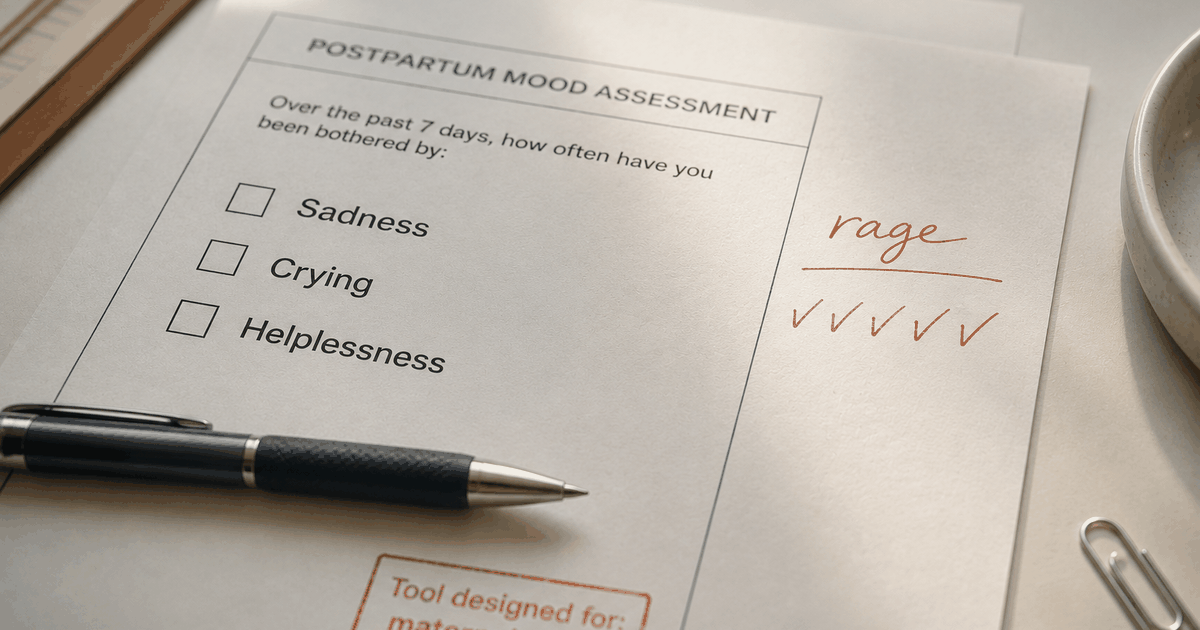
When people imagine postpartum depression, they picture crying. Helplessness. A person who can't get out of bed.
New fathers with postpartum depression mostly don't cry. They get angry. They snap at small things. They lie awake in a kind of low-grade fury they can't explain. They watch themselves become someone they don't recognize, and then feel ashamed of the watching.
For years the research largely missed this — because postpartum depression was studied almost exclusively in mothers, using tools designed to detect sadness, not rage. A body of emerging research is now catching up, and what it's finding reshapes how we should think about the first year of fatherhood.
What researchers found when fathers spoke anonymously
Anger is one of the clearest signals researchers see when fathers describe paternal postpartum depression in their own words. A qualitative study published in September 2025 in Global Qualitative Nursing Research analyzed anonymous Reddit posts by fathers who self-identified as experiencing paternal PPD, and found a distinct cluster of experiences — anger, irritability, frustration, and rage — that the authors termed masked symptoms: presentations that fall outside the diagnostic criteria written for maternal depression, yet were among the most consistently described.
The researchers deliberately turned to Reddit because it was one of the few places fathers were saying any of this at all — a paper on how frightened new fathers struggle to name what they feel describes the same silence. Fathers described paternal PPD as something "whispered on only the darkest corners of the internet" — not with their partner, not with friends, not with a doctor. The anonymity wasn't a quirk of the data source. It was the point. These men felt they had nowhere else to say it.
| Title | "Whispered on Only the Darkest Corners of the Internet": A Qualitative Descriptive Study Exploring Fathers' Experiences with Paternal Postpartum Depression on Reddit |
| Authors | Richardson, Graf, Hicks & Caiola (2025) · East Carolina University + UNC Chapel Hill |
| Journal | Global Qualitative Nursing Research (Sep 27, 2025) · DOI 10.1177/23333936251374618 |
| Method | Thematic analysis of fathers' anonymous first-person posts about paternal PPD |
| Headline finding | Anger and irritability appear as "masked symptoms" not captured by maternal diagnostic criteria |
One father wrote: "Even the smallest noise from my kids instantly puts me on edge. I'm overwhelmed by intense anger that feels irrational and frightening. I know they're just babies who can't help how they express themselves, but that doesn't stop the constant waves of rage and frustration that feel like they're wearing down my sanity."
Another described: "When I'm caring for our baby, I'm consumed by feelings of anger and resentment. I had hoped those feelings would fade over time and that I'd begin to bond with him, but instead they've only intensified." It's a feeling many fathers who feel rejected and shut out after the baby will recognize.
The same pattern turns up beyond Reddit. A separate 2025 paper, "The Lived Experiences of Fathers with Postpartum Depression" (American Journal of Nursing), documents fathers describing irritability and emotional shutdown rather than the visible sadness clinicians are trained to look for.
of new fathers experience postpartum depression — and that figure is likely an underestimate, because there's no standard screening protocol for fathers and the male presentation (anger, irritability, emotional numbing) doesn't align with criteria built around maternal depression. In some samples it runs closer to 1 in 5.
Why anger, not sadness? The idea of "masked" symptoms
Men's depression often shows up as anger and action rather than sadness and withdrawal — not because men feel less, but because social conditioning around male emotion redirects distress outward. When diagnostic criteria don't capture that, men go undiagnosed; when they go undiagnosed, they don't get help; and their families absorb the cost.
The masked-symptoms framing draws on a well-established body of gender-differentiated depression research. When a man is overwhelmed, isolated, and exhausted — as most new fathers are — the pathways through which that distress moves are different from what the Edinburgh Postnatal Depression Scale was built to detect.
This matters practically. A father who answers "not much" to "have you been feeling sad?" but would answer "constantly" to "have you been feeling irritable and short-fused?" is not less depressed. He is differently depressed — and the screening never asked the right question.
"Feeling isolated and like you have to work things out on your own and not ask for help is a uniquely male view that can lead to numbness and detachment."Raymond Levy, PsyD, Harvard Medical School / Massachusetts General Hospital (Fatherly)
Here's the same distress, side by side — how depression is described in the textbook versus how it often shows up in dads:
| Symptom lane | Classic (maternal-built) picture | How it often shows in dads |
|---|---|---|
| Mood | Persistent sadness, crying, hopelessness | Irritability, short fuse, rage at small things |
| Behavior | Withdrawal, difficulty bonding with baby | Emotional numbing, throwing self into work |
| Self-perception | Guilt, feeling of failure as a parent | Feeling like "a different person," shame at the anger |
| Help-seeking | More likely to reach a doctor | Talks anonymously online before a clinic |
| Diagnostic capture | Standard Edinburgh Scale detects it | Standard scale often misses it entirely |
The relationship connection: what a second 2025 study found
Relationship quality behaves like a protective factor against a father's anger over time. A prospective cohort study published in 2025 in Frontiers in Psychology (the DREAM study) found that lower relationship satisfaction predicted more symptoms of anger and hostility later, while fathers with greater relationship satisfaction and perceived social support reported fewer — social support even buffered the link when satisfaction was lower.
| Title | Parental relationship satisfaction, symptoms of depression and anger/hostility, and the moderating role of perceived social support — a prospective cohort study (DREAM study) |
| Authors | Kümpfel, Weise, Mack & Garthus-Niegel (2025) · TU Dresden + Medical School Hamburg + Norwegian Institute of Public Health |
| Journal | Frontiers in Psychology (2025) · DOI 10.3389/fpsyg.2025.1470241 |
| Design | Prospective cohort, fathers and mothers assessed across the first two years postpartum |
| Headline finding | Relationship satisfaction and social support predict fewer anger/hostility symptoms in fathers over time |
This inverts the usual framing. We tend to think of anger as the cause of relationship problems — the irritable dad damages the marriage. The data suggests the arrow also runs the other way: relationship quality shapes how much anger accumulates in a father over time.
Which means the way a couple stays connected in the first two years of parenthood isn't just nice-to-have. It behaves like a mental-health variable — one linked to whether a dad ends up angrier or calmer by year two.
What this means for you tonight
If you've been angrier than usual since the baby arrived — and it feels disproportionate, or unlinked to anything specific, or it's gone on for more than two weeks — that's the data point worth acting on. Not by suppressing it. By naming it.
Many fathers only disclose this in anonymous spaces because they don't want to add to their partner's burden. That instinct — protect her, swallow it yourself — is understandable. It's also how paternal PPD goes unaddressed for months while it quietly damages the relationship it was trying to protect.
Two concrete moves. First, name it out loud to someone who can help — your GP, a therapist, or your partner. If you're not sure whether what you're feeling counts, a two-minute new-dad mental-health check can help you decide whether to raise it now. Second, protect the couple: the DREAM study points to small, consistent connection as something closer to neurologically protective against anger accumulation than a soft extra. Not therapy, not a big talk — one small moment of feeling less alone, repeated over time.
That's harder than it sounds in a year when nothing has margins. Which is exactly the problem the research is pointing at.
Frequently asked questions
Why do new dads get so angry and irritable after having a baby?
Anger and irritability in new fathers are often "masked symptoms" of paternal postpartum depression — a way depression manifests in men that is not captured by the standard criteria designed for maternal depression. A 2025 qualitative study analyzing fathers' anonymous accounts on Reddit (Richardson et al., Global Qualitative Nursing Research) found anger and irritability described as a masked presentation of paternal PPD — distinct from the sadness more typically associated with depression.
Is it normal to feel angry all the time as a new dad?
Persistent irritability, a short fuse, or disproportionate anger lasting more than two weeks is worth naming — not normalizing. About 10% of new fathers develop postpartum depression (Paulson & Bazemore, JAMA, 2010), and in men it frequently presents as anger or emotional numbing rather than sadness. If the anger feels unfamiliar or out of character, that distinction matters.
What is paternal postpartum depression and how is it different from maternal PPD?
Paternal postpartum depression affects roughly 10% of new fathers in the first year. Unlike maternal PPD, which more often presents as sadness, crying, and withdrawal, paternal PPD frequently presents as irritability, anger, and emotional numbing. These "masked symptoms" are not reflected in diagnostic criteria built around maternal depression, which is one reason paternal PPD is significantly underdiagnosed.
Does being unhappy in my relationship make me angrier as a new dad?
The evidence points that way. A 2025 prospective cohort study (Kümpfel et al., Frontiers in Psychology, DREAM study) found that lower relationship satisfaction predicted more symptoms of anger and hostility later, while fathers with greater relationship satisfaction and perceived social support reported fewer anger/hostility symptoms. Relationship quality behaves like a measurable protective factor, not just a soft benefit.
What should I do if I'm an angry new dad?
The first step is naming it to a professional, not just to yourself. Tell your GP or doctor: "I've been unusually irritable since the baby arrived and it's been more than two weeks." That single sentence is enough to open a real conversation. A quick self-check like Regular's new-dad mental-health check can help you decide whether to raise it now — and daily connection with your partner is a measurable protective factor, not a luxury.
Keep readingNew-dad mental-health check · 1 in 5 new dads have postpartum depression or anxiety · Why new dads feel rejected after a baby · Fathers are frightened — they just can't name it
Co-founder & CPO of Regular; Prof. Dr. in AI and institute director at THWS Würzburg. Writes “The Science, decoded” — reading the primary research so every claim traces to a citable source.
About Regular — the relationship app for new dads, built by a small team of parents who needed it themselves. Small, science-backed moves with your partner, not big talks.